

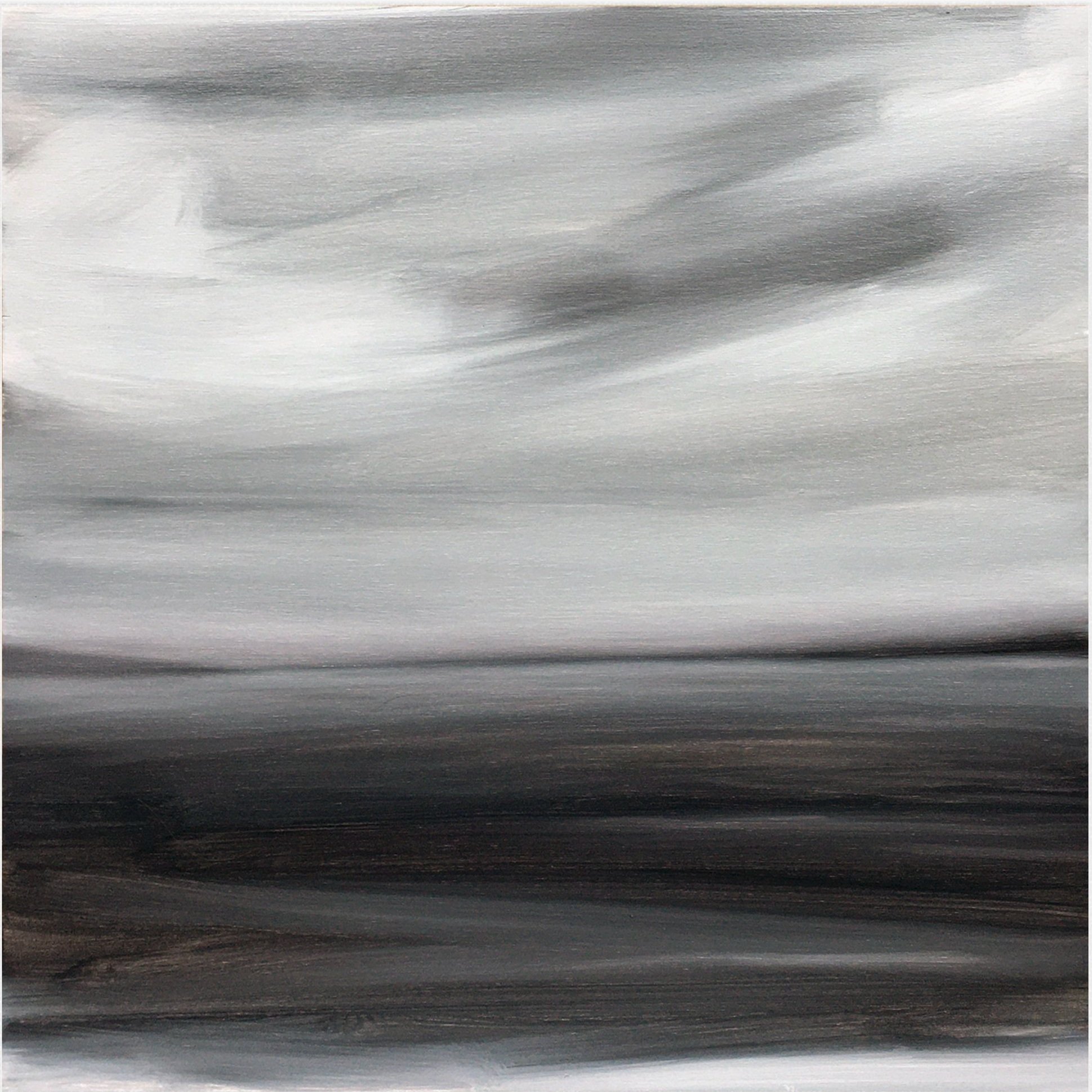
storm in late may, 2021
About
–––
Mark Johnson is a painter and printmaker working in New York and coastal Maine. His work has been shown in the United States and abroad, including the 2025 Biennial at the Center for Maine Contemporary Art, Planthouse Gallery (New York), the Print Center New York, and Susan Maasch Fine Art (Portland, ME). His work appears in David Hornung's Color: A Workshop for Artists and Designers. He holds a BA from Oberlin College and an MA from New York University, and has taught at New York University since 1995 and Northeastern University—New York City since 2021.
Artist Statement:
In 1969, two experiences were formative: watching the first human walk on the moon and moving with my family to India for a year. One took place in space, the other on Earth, but together they opened a sense of scale and possibility that has never left — and that continues to shape how I think about the world and about making art.
My paintings and prints return again and again to the same set of opposites: abstraction and representation, stillness and movement, near and far, the known and the unknown, form and idea.
Unsettled Weather and Seascape Paintings:
The experience of living for extended periods of time on Pumpkin Knob, a small island in Casco Bay, Maine, without electricity or running water, is at the core of my paintings. I am literally surrounded by weather, tides, moon cycles, cloud formations, and the play of wind — a world in constant motion and flux. The physical landscape and the transient states of the sea and sky provide endless opportunities to explore these opposites, while underscoring my view of art as both a form of communication and a means for contemplation.
Storms and fog have been recurring subjects. What began as a way of working with a continually changing environment has gradually become a broader reflection on uncertainty and duration.
Event Horizons and Energy Field Paintings:
The Event Horizons paintings come out of thinking about origins: the moment when darkness became light, the edge of a black hole, the limits between what can and cannot be seen.
The Energy Fields trace world lines — paths of energy moving through structure, partly concealed, partly visible, known only by what they leave behind.
Prints:
My print practice runs parallel to the paintings and shares the same concerns — scale, energy, the limits of what can be made visible. I studied viscosity color printing with Krishna Reddy, who developed the process at Atelier 17 in Paris in the 1950s, and color has remained central to both practices ever since: not applied to a surface but produced by the interaction of materials. The print series — Chart Series, Galaxies, and Dark Matter — move between traditional intaglio, laser-cut plates, and large-scale digital printing, but the exploration was never about the technology, but about finding new ways of expressing ideas.
Chart and Galaxy Series
I was teaching at NYU in 2003 when it acquired a laser cutter. The day it arrived I asked what it did and was told that it etches and cuts material. As a printmaker who made etchings, I thought: I etch material — so I asked to try it. The Chart Series, made between 2006 and 2008, was the result: modified PDF star charts and "world lines" drawn with a computer mouse, etched onto separate plates. The Galaxies series followed, extending the same process into deeper astronomical territory. I did not know what the images would become. Printing settled it, proof by proof, until the composition arrived.
Dark Matter
I learned Illustrator only to make files for the laser cutter. Then I found I liked working in it, and wanted digital prints that didn't rely on photography — so I built the images from simple geometry, drawn rather than captured. Printed large-scale, they became explorations of color and of the limits of the inkjet printer. The world lines arrived last, at the very end — the same lines that run through everything.
The form that keeps falling short and the mind that keeps looking for what it can't contain.